
NHS theatre digitisation and productivity - insights from the National Operating Theatres Show

Across the NHS, Scan4Safety has become a national priority, with digital traceability positioned as a cornerstone of patient safety, regulatory compliance and productivity.
But while the policy ambition is clear, the reality inside operating theatres is often very different.
At the National Operating Theatre Show 2026, NHS clinical and operational leaders came together for an honest discussion about what it actually takes to implement point‑of‑care scanning and inventory management in live theatre environments - including the challenges, misconceptions and lessons learned from real‑world rollout.
From ambition to reality in the operating theatre
Operating theatres face growing pressure from every direction: productivity targets, patient safety requirements and regulatory scrutiny are all increasing, often all at the same time and with competing importance.
As the discussion opened, the panel reflected on the gap that can exist between national policy and day‑to‑day practice:
Digital traceability is increasingly recognised as essential for patient safety, but the difference between policy intent and what happens in theatres can be considerable.
Too often, essential processes still rely on manual steps: paper records, handwritten serial numbers and duplicated data entry across multiple systems. These are not just inefficient, but introduce real risk.
Why manual processes fail when it matters most
From a clinical perspective, the panel shared examples where manual processes simply do not stand up under pressure.
Ish Ahmed, Surgeon, North Tees and Hartlepool NHS Foundation Trust, and GIRFT Advisor, described a historic implant recall. Prior to point‑of‑care scanning, identifying affected patients would have meant manual reviews across multiple systems, a process that could take weeks.
With scanning in place:
“We pressed a button. In 17 minutes, we had identified more than 1,300 affected records and knew exactly which patients were impacted.”
The discussion also highlighted how regulatory alerts, sometimes issued months before a device is used, are difficult to rely on in practice. Posters on walls and email reminders are easily missed in busy clinical environments.
Point‑of‑care scanning provides real‑time decision support, acting as what the surgeon described as:
“A second pair of eyes at the moment of use.”
The operational impact: stock, waste and hidden costs
From an operational and procurement perspective, manual inventory processes create problems at every step.
Without accurate, real‑time data:
Stock levels are inflated just in case
Expiry‑related waste increases
Replenishment is reactive rather than planned
As Marc Saaiman, Deputy Head of Procurement at South Tees Hospitals NHS Foundation Trust explained:
“Because the process is so hard, we often end up holding more stock than we should, and that leads directly to waste.”
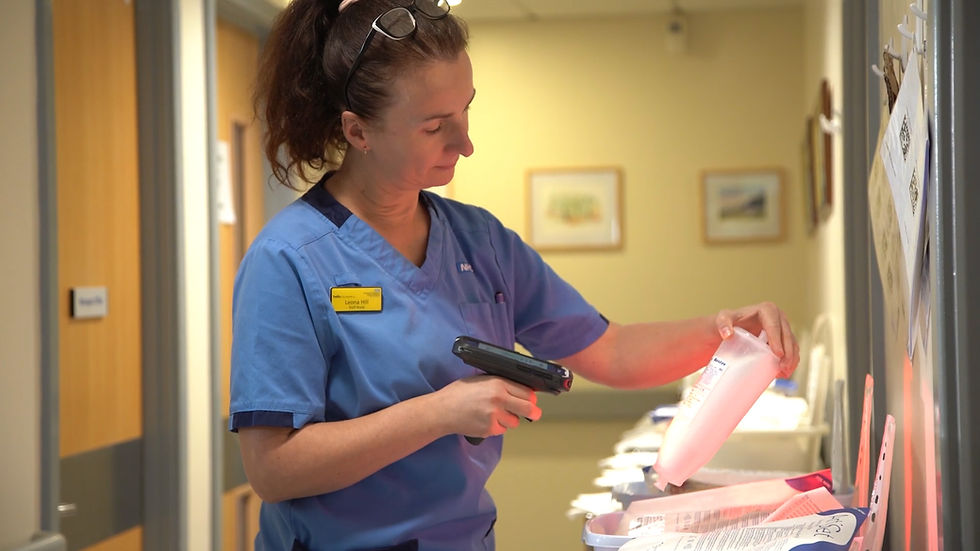
Embedding scanning at the point-of-care changes this dynamic. Data captured once can be reused across multiple systems, including inventory management, finance reporting and national submissions.
In one Trust, this approach enabled a £1.5 million reduction in stock, and nearly 50% of excess inventory removed from shelves, achieved in partnership with clinical teams.
Will this slow theatres down?
A key theme throughout the discussion was the misconception that Scan4Safety initiatives add time or administrative burden for clinical teams.
In practice, the opposite can be true. When scanning is built into theatre workflows, it replaces manual writing and typing, it reduces duplication, and it often saves time overall.
As one panellist described:
“If scanning is part of the flow, it’s far quicker than writing serial numbers or entering data later. It doesn’t add effort, it removes it.”
This shift in perception becomes easier once teams experience the impact first-hand.
What makes implementation work?
One of the strongest messages from the panel was that successful Scan4Safety implementation is not owned by any single department; instead, it requires early and ongoing involvement from:
Clinical teams
Operational and procurement leads
Digital and IT teams
Finance, governance and safety
The panel returned to a simple principle: people first, then process, then technology.
For Trusts looking to start, they were encouraged to start by asking questions to identify gaps.
How would an implant recall be managed in your organisation today?
Could outcome registries be supported in real-time?
Where do manual steps introduce risk in your day-to-day workflows?
The introduction of technology should take place based on a real understanding of 'why?', with clarity on where savings and efficiencies can be made, not for the sake of digitising alone.
From nice-to-have to essential infrastructure
A decade into the Scan4Safety programme, expectations are changing. Outcome registries and increasing regulatory demands are difficult, if not impossible, to meet without robust, real‑time data capture.
As one speaker summarised:
“Scan4Safety is no longer optional. As clinicians, we need to know that what we’re using is safe, traceable and supported by reliable data.”
Watch the full discussion here.
This discussion took place at The National Operating Theatre Show held at The Kia Oval on 10th March 2026, and was facilitated by CareScan. The views shared reflect the speakers’ own clinical and operational experience.


Comments